How to Qualify a CNC Machining Supplier in 2026
Written by Dynamics Group, an ITAR-registered Michigan design-build manufacturer. See author credentials for facility, quality, and inspection evidence.
Key Takeaways: How to Qualify a CNC Machining Supplier in 2026
- A wrong supplier costs 5-10x the quoted price difference in rework, scrap, and schedule slips for OEM programs.
- Pre-qualification screening on capability, tolerances, and capacity eliminates roughly 60-70% of mismatched vendors.
- Quality certifications like ISO 9001, AS9100, and IATF 16949 indicate documented processes but require independent verification.
- Dynamics Group returns most quotes within 24 hours and keeps design, machining, and inspection under one roof.
- Ongoing scorecards tracking on-time delivery, defect rates, and corrective action response times sustain supplier performance.
Why Qualifying Your CNC Machining Supplier Matters for OEM Programs
The cost of a wrong supplier never shows up in the unit price. It surfaces downstream as rework, scrap, missed ship dates, and quality escapes that erode your team's credibility with internal stakeholders and end customers.
Industry data consistently shows that 60-70% of manufactured-part quality issues trace back to supplier selection rather than design errors. A single quality escape on a defense component or automotive production part can cost $10K-$100K+ per event when you factor in investigation, containment, corrective action, and customer impact.
The 20-40 hours you invest in qualifying a new supplier typically pays back on the first production order. This guide walks through the complete process from initial screening to ongoing performance tracking.
What Does It Mean to Qualify a CNC Machining Supplier?
Supplier qualification is the process of verifying that a CNC machining vendor can consistently meet your engineering requirements, quality standards, delivery timelines, and documentation needs before you commit production work to them.
For OEM procurement teams, qualification goes beyond checking a box. It means confirming that the supplier's equipment matches your part geometry, that their quality system produces repeatable results, and that their communication practices fit your program cadence.
A qualified supplier is one where you have evidence of their capability rather than just their claims. That evidence comes from capability questionnaires, quality system audits, trial orders with first article inspection, and ongoing performance metrics.
How to Screen CNC Machining Suppliers Before Requesting a Quote
Before sending a drawing, verify basic alignment on process capability, equipment, tolerances, materials, and capacity. A 30-minute screening call eliminates most mismatched suppliers and saves everyone time.
Confirm Process Capability and Equipment Match
CNC machining is not one thing. A 3-axis shop quoting 5-axis work will either sub it out (losing control) or attempt it on inadequate equipment. Ask what machines they run, what axis count, and what their maximum travel envelope is.
Request an equipment list with make, model, axis count, and work envelope. For CNC milling, confirm whether they have 5-axis simultaneous or 3+2 positioning. The distinction matters for complex contoured surfaces that require continuous interpolation.
Verify Tolerance Capability
Every shop has a standard tolerance band and a precision tolerance band. Verify that your critical tolerances fall within their standard band rather than their heroic one-off capability. A shop whose standard tolerance is ±0.005" can likely hold ±0.001", but at significantly higher cost and reject rate.
Ask what their standard holding tolerance is for CNC-machined features in your target material. If the answer is vague, that is a yellow flag. Qualified shops know their process capability quantitatively.
Check Material and Finish Experience
Confirm the supplier has experience with your specific alloy or grade. A shop that routinely machines 6061-T6 aluminum may have difficulty with Inconel 718 or titanium Ti-6Al-4V due to different tool wear, cutting speeds, and coolant requirements.
Ask for 2-3 examples of parts they have produced in your target material. If they cannot provide examples, the learning curve will be on your dime.
Assess Capacity and Lead Time Reality
A shop that quotes 3-week lead time but is running at 90% capacity will slip. Ask about current capacity utilization, shift patterns, and how they handle demand spikes. For production orders, confirm they can sustain your required delivery cadence.
Evaluate Inspection Equipment
The supplier's inspection capability must match your drawing requirements. If you call out GD&T per ASME Y14.5, they need a CMM rather than just calipers and micrometers. If you require surface finish verification, they need a profilometer.
Ask for the make and model of their CMM and the date of last calibration. Calibration intervals should be 6-12 months per ISO 10012. Dynamics Group maintains ISO 9001-compliant quality processes with a Mitutoyo AE112 CMM, Keyence XM-5000 probe CMM, and Artec Leo 3D scanner for verification.
What Quality Certifications Should a CNC Machining Supplier Have?
Not all quality certifications are equal. Match the supplier's quality system to your industry's regulatory and contractual requirements.
ISO 9001:2015 for General Commercial Work
ISO 9001 is the baseline quality management system covering document control, corrective action, management review, internal audits, and process approach. It is appropriate for commercial CNC, sheet metal, or 3D printing parts without industry-specific regulatory requirements.
AS9100 for Aerospace and Defense
AS9100 adds aerospace-specific requirements including configuration management, first article inspection per AS9102, risk management, counterfeit parts prevention, and special process control. Require it for flight-critical hardware, space systems, and defense components with traceability requirements.
IATF 16949 for Automotive Supply Chains
IATF 16949 builds on ISO 9001 with automotive-specific requirements: APQP (advanced product quality planning), PPAP (production part approval), SPC (statistical process control), MSA (measurement system analysis), control plans, and FMEA. Require it for automotive OEM or Tier 1/Tier 2 supply chain parts.
Verify Certifications Independently
A certification tells you the supplier has a quality system. It does not tell you they make good parts. ISO 9001 and AS9100 certificates can be checked on the IAF CertSearch database. Expired or suspended certifications are more common than you would expect. Always verify before you qualify.
How to Evaluate CNC Machining Capability and Equipment
CNC shops require evaluation criteria beyond what applies to 3D printing or sheet metal vendors. When vetting a machine shop, focus on these CNC-specific factors.
Spindle Hours and Machine Age
A vertical machining center with 20,000+ spindle hours will have difficulty holding tight tolerances regardless of the operator's skill. Ask for the machine's year of manufacture and approximate spindle hours. Shops that track spindle hours have better maintenance discipline.
3-Axis vs. 5-Axis Machining Capability
Confirm whether the shop runs true 5-axis simultaneous machining or 3+2 positional. If your part has contoured surfaces requiring simultaneous interpolation, 3+2 will not produce the same result. Ask for the make and model of their 5-axis equipment.
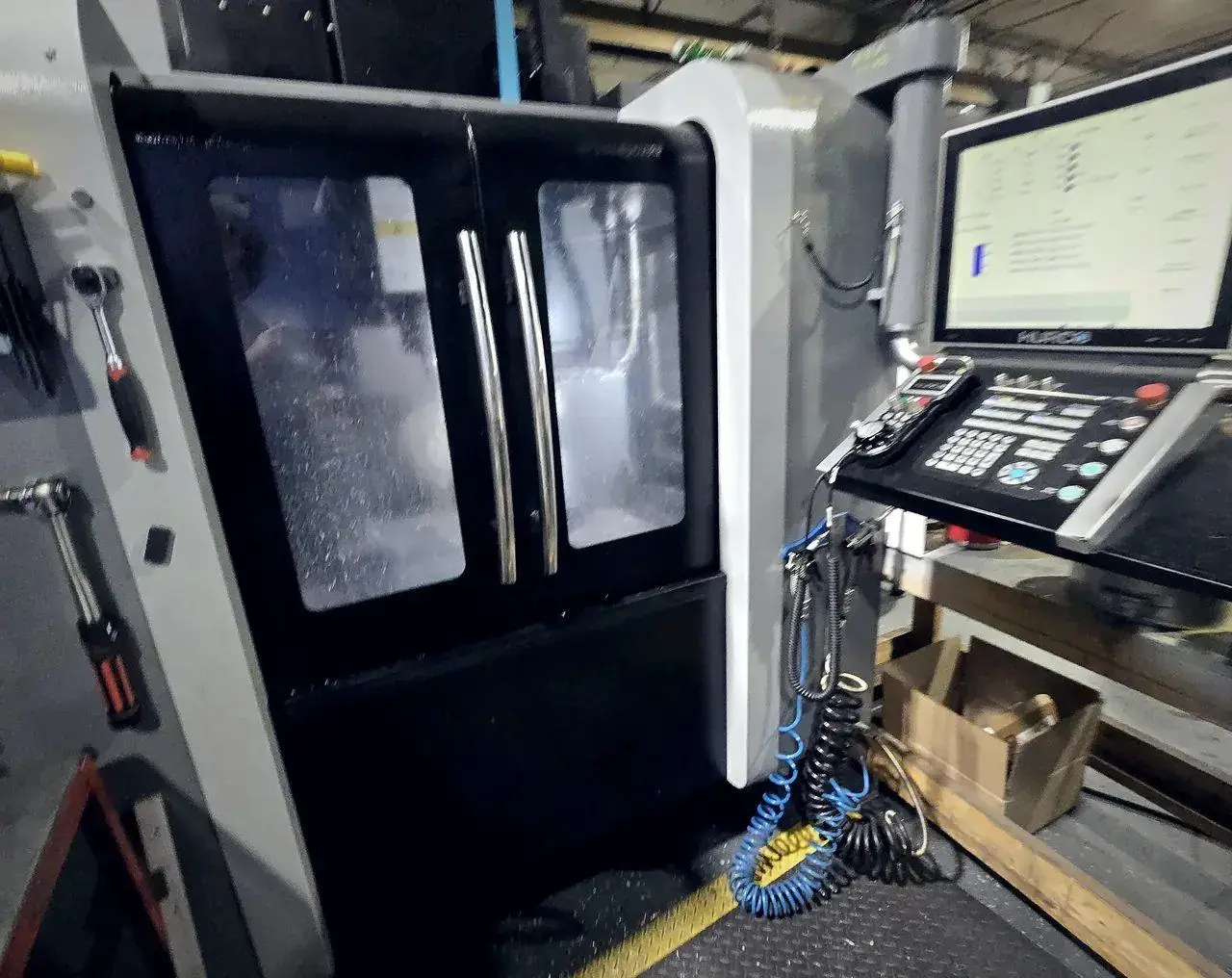
Dynamics Group runs 5-axis machining on a Hurco VM10UHSi swivel-head machining center for the geometry that three axes cannot reach efficiently, with milling envelopes to 51 x 22 x 20 inches across six vertical machining centers.
Tooling Library and Tool Management
A well-run CNC shop maintains a standard tooling library with documented tool life data. Ask how they manage tool wear compensation. Shops that rely on operator judgment rather than tool-life tracking will produce inconsistent parts across a production run.
Process Capability Data (Cpk)
For production-critical features, ask for Cpk data from a recent production run. A qualified CNC shop should be able to demonstrate Cpk ≥ 1.33 on critical dimensions. If they cannot provide Cpk data, they are not running statistical process control.
How to Structure a Trial Order for CNC Machining Qualification
A controlled trial order with first article inspection is the most reliable way to validate a new supplier's actual capability rather than their quoted capability.
Design the Trial Order with Multiple Parts
Order 3-5 identical parts, not just one. A single part can be nursed through the shop on a manual machine by the most experienced operator. Multiple parts force the supplier to set up a repeatable process.
Choose a part that represents your typical complexity, tolerance range, and material. If you have both simple brackets and tight-tolerance housings in your typical work, order both as part of the trial.
Require a Balloon Drawing and Full Dimensional Report
A balloon drawing numbers every dimension and tolerance on the engineering drawing. The first article inspection report maps every balloon number to a measured value, stated tolerance, and pass/fail status. This is industry-standard FAI practice.
Provide the supplier with your balloon drawing template. Specify whether you want CMM data, caliper/micrometer measurements, or both. For regulated industries, align the FAI scope with your design history file requirements.
Define Accept/Reject Criteria Before Parts Ship
Before the trial order ships, define what pass looks like. Typical criteria: 100% of critical dimensions in tolerance, at least 95% of non-critical dimensions in tolerance, all material certifications provided, surface finish within specification on inspected surfaces.
Document your accept/reject criteria in the purchase order or a separate quality requirements document. This prevents negotiation after the fact when some dimensions are out of specification.
Perform Independent Incoming Inspection
Do not rely solely on the supplier's self-inspection report. Perform your own incoming inspection on the trial parts or use an independent third-party inspection house. Compare your measurements to theirs. Discrepancies reveal measurement system issues that will cause problems in production.
What to Look for in Supplier Communication and Responsiveness
Even the most capable manufacturer will not help you much if you cannot get in touch with them. Evaluate a provider's approach to communication and support early in the qualification process.
Quote Turnaround Time
The quoting phase is a free audit. A supplier's responsiveness during quoting predicts their behavior during production. If the quote experience is painful, production communication will be worse.
Track quote turnaround time as a qualification metric. Qualified suppliers typically return quotes within 3 business days for standard work. Dynamics Group returns most quotes within 24 hours, with same-day replies during shop hours.
Direct Access to Technical Staff
Ask whether you will have direct access to a knowledgeable person or if communication goes through a ticket queue or automated system. Direct access to engineering and manufacturing staff accelerates problem resolution during production.
Dynamics Group provides direct access to engineering and manufacturing staff rather than routing questions through a ticket system. That accessibility matters when you need to resolve a tolerance question before the next operation.
Revision Control Process
Ask how the supplier handles drawing revisions. If you send a rev B drawing, how do they ensure rev A is removed from the shop floor? If the answer is vague or involves verbal communication only, expect wrong-revision parts.
How to Assess Single-Source Accountability in CNC Suppliers
When design and manufacturing happen at separate companies, every tryout problem becomes a commercial argument. Schedule risk multiplies as work moves between vendors who point fingers at each other.
Why Integrated Design and Build Matters
A supplier that handles design, machining, fabrication, and inspection in the same building eliminates the handoffs that cause schedule slips. When a problem is found at tryout, it is a conversation rather than a change order and a four-week loop through an outside shop.
Dynamics Group keeps design, metal, fabrication, and CNC machining under one roof. One local team owns the part from print to shipment, which eliminates the commercial arguments that slow down multi-vendor programs.
Evaluate Vertical Integration
Ask what percentage of work the supplier performs in-house versus subcontracts. Subcontracting is not inherently bad, but it adds lead time and reduces control. For critical parts, you want the supplier to control as much of the process as possible.
A vertically integrated supplier can also help you consolidate vendors. Instead of coordinating four suppliers to produce one part, you work with one accountable partner for design, machining, fabrication, assembly, and inspection.
How to Set Up Ongoing Supplier Performance Metrics
Qualification is not a one-time gate. Track these metrics quarterly to detect degradation before it becomes a quality escape or a missed shipment.
On-Time Delivery (OTD)
Target at least 95% on-time delivery. Measure ship date against purchase order required date. Count early deliveries as on-time only if approved. Take action when OTD drops below 90% for two consecutive months.
Defect Rate (PPM)
Target less than 1,000 parts per million defective. Calculate as nonconforming parts divided by total parts received multiplied by 1,000,000. Track at incoming inspection. Take action above 2,500 PPM on any single lot.
First-Pass Yield
Target at least 97% first-pass yield. Calculate as parts accepted at incoming inspection divided by total parts received. Reworked parts count as failures. Take action when yield drops below 95% on any order.
Corrective Action Response Time
Target 5 business days or less from nonconformance report issuance to documented root cause analysis. Take action when response time exceeds 10 business days or when no root cause is provided.
Share the Scorecard with Suppliers
Suppliers who see their metrics tend to improve when given visibility. Those who do not improve after two review cycles are unlikely to improve at all. Start qualifying a replacement when patterns persist.
Red Flags That Should Disqualify a CNC Machining Supplier
These warning signs during evaluation almost always predict problems in production. It is far less expensive to walk away during qualification than to recover from a failed production lot.
Refuses to Sign a Mutual NDA
If a supplier will not sign a mutual NDA before reviewing your drawings, they either lack a legal process or do not respect IP protection. Both are disqualifying for any proprietary design work.
Cannot Produce Sample Inspection Reports
If the supplier cannot provide a sample dimensional inspection report from a previous job (redacted for confidentiality), they likely do not perform in-process or final inspection systematically. Your parts will not be inspected either.
No Material Certifications Available
Mill certifications trace raw material back to the producing mill and verify alloy composition, heat number, and mechanical properties. A supplier who cannot provide mill certs is either not requesting them from their material distributor or not maintaining traceability.
Pricing Does Not Separate NRE from Recurring Costs
If the quote lumps tooling, fixturing, and programming (NRE) into the per-part price, you cannot evaluate the true unit cost. It also means you will pay for tooling again on every reorder. Qualified suppliers always separate NRE from recurring cost.
Quotes Tolerances They Cannot Hold
A shop that quotes ±0.0005" on every feature without questioning it is either not reading your drawing or plans to charge you for rejects. Qualified suppliers ask clarifying questions about tight tolerances because they know what costs more.
How to Handle Controlled Technical Data with CNC Suppliers
If your parts involve ITAR-controlled data, export-controlled technical information, or proprietary designs, the supplier's data handling practices become a qualification requirement.
ITAR Registration for Defense Work
For defense-related drawings and technical data, require ITAR registration. The supplier must handle controlled technical data under restricted access, with documented data-handling procedures. Data should never be shared with offshore suppliers.
Dynamics Group is ITAR-registered with a Madison Heights, Michigan facility that handles controlled technical data under restricted access. Defense primes and their Tier 1 suppliers can send controlled technical data with confidence.
Documentation That Survives an Audit
Qualified suppliers retain material certifications, inspection records, and first-article reports for every job. Ask about their record retention policy and how they respond to customer audits. The documentation trail should be retrievable years after the work shipped.
How Long Does CNC Supplier Qualification Take?
A thorough qualification takes 20-40 engineering hours and 4-8 weeks depending on the complexity of your requirements and the supplier's responsiveness.
Phase 1: Pre-Screening (1-2 Weeks)
Send a capability questionnaire, verify certifications on public databases, and evaluate quoting responsiveness. This 2-4 hour investment eliminates most mismatched suppliers before you spend money on trial parts.
Phase 2: Quality System Review (1-2 Weeks)
Review sample inspection reports, verify special process certifications, and assess documentation practices. For critical suppliers, conduct an on-site audit or desk audit of their quality system.
Phase 3: Trial Order and FAI (2-4 Weeks)
Order 3-5 parts with full first article inspection. Inspect independently. A trial order costing several hundred to a few thousand dollars is the most reliable predictor of production quality.
Maintain Qualification Through Ongoing Scorecards
Track on-time delivery, defect rates, first-pass yield, and corrective action responsiveness quarterly. Share results with the supplier. Replace underperformers before they cause a field escape.
Supplier Qualification Checklist for OEM Procurement Teams
Use this checklist as a starting point for your supplier qualification procedure. Each item maps to a section in this guide.
Pre-Screening Checks
- NDA signed and executed
- Capability questionnaire completed with equipment list
- Equipment list reviewed (machines, CMM, profilometer)
- Tolerance capability confirmed for your critical features
- Material experience verified with example parts
Quality System Checks
- Quality certification verified (ISO 9001, AS9100, IATF 16949 as applicable)
- Certification checked on IAF CertSearch or OASIS database
- Special process certifications verified (heat treat, plating, welding)
- Sample inspection report reviewed
- ITAR registration confirmed for controlled data (if applicable)
Trial Order Checks
- Trial order placed for 3-5 parts
- Balloon drawing provided to supplier
- First article inspection report received and reviewed
- Independent incoming inspection performed
- Accept/reject criteria met
- Material certifications received
Ongoing Performance Checks
- Scorecard metrics baselined (OTD, PPM, first-pass yield, CAPA response)
- Quarterly review cadence established
- Supplier performance shared and discussed
Why Responsive Quoting Predicts Production Performance
Quote turnaround time is one of the most underrated supplier qualification metrics. A supplier's behavior during quoting predicts their behavior when you have parts in production.
Fast Quotes Indicate Process Discipline
A shop that returns quotes within 24 hours has their estimating process dialed in. They understand their costs, their capacity, and their capabilities. That same discipline typically carries through to production planning and delivery.
Dynamics Group returns most quotes within 24 hours and provides same-day replies during shop hours. That responsiveness reflects the same process discipline applied to production machining and delivery.
Questions During Quoting Are a Good Sign
A supplier who asks clarifying questions about your tolerances, critical features, and acceptance requirements is reading your drawing carefully. They want to understand the job before committing to a price. That attention to detail predicts attention to detail in production.
In Summary: How to Qualify a CNC Machining Supplier in 2026
Supplier qualification is the highest-leverage activity in your procurement process. The 20-40 hours you invest in screening, quality system review, and a controlled trial order prevent the 200-400 hours you would spend managing quality escapes, rework cycles, and delivery failures from an unqualified source.
Start with pre-screening on capability, tolerances, and equipment. Verify quality certifications independently and review sample inspection reports. Run a trial order with 3-5 parts and full first article inspection. Then sustain qualification with quarterly scorecards that track on-time delivery, defect rates, and corrective action responsiveness.
For OEM procurement teams looking for a CNC machining partner that returns quotes within 24 hours, holds tolerances to ±0.0002" on critical features, and keeps design through inspection under one roof, request a quote from Dynamics Group or call (586) 684-4676.
FAQs about How to Qualify a CNC Machining Supplier in 2026
How long does it take to qualify a CNC machining supplier?
A thorough qualification typically takes 4-8 weeks, including pre-screening, quality system review, and a trial order with first article inspection. The 20-40 hours of engineering time invested prevents far greater costs from quality escapes and schedule slips later.
What certifications should I require from a CNC machining supplier?
Require ISO 9001 for general commercial work, AS9100 for aerospace and defense, and IATF 16949 for automotive supply chain parts. Verify certifications independently on the IAF CertSearch database. Dynamics Group maintains an ISO 9001-compliant quality system and ITAR registration for defense work.
How many suppliers should I qualify for each CNC machining process?
Qualify 2-3 suppliers per process for critical production work. This dual-sourcing strategy protects against capacity constraints, quality issues, and business disruptions at any single supplier without fragmenting your volume too much.
What should I include in a supplier capability questionnaire?
Include questions about equipment list with make/model, tolerance capability by material, quality certifications, inspection equipment, capacity utilization, shift patterns, lead times, and material experience. Request example parts and sample inspection reports.
How do I verify a supplier's tolerance capability?
Ask for their standard holding tolerance by material and feature type. Request Cpk data from a recent production run for critical dimensions. A qualified CNC shop should demonstrate Cpk of at least 1.33. Dynamics Group publishes capability to ±0.0002" on critical features.
What is the difference between a supplier audit and a supplier assessment?
An assessment reviews documentation and questionnaire responses remotely (desk audit). An audit involves on-site verification of processes, equipment, and quality system implementation. Use assessments for initial screening and audits for critical supplier qualification.
What ongoing metrics should I track for qualified CNC suppliers?
Track on-time delivery (target at least 95%), defect rate in PPM (target under 1,000), first-pass yield (target at least 97%), and corrective action response time (target 5 business days or less). Share scorecard results quarterly with suppliers.
When should I re-qualify a CNC machining supplier?
Re-qualify when a supplier experiences significant changes: ownership change, facility relocation, major equipment changes, quality certification lapse, or persistent scorecard failures. Annual review of qualification status is good practice for critical suppliers.
Steps
-
01
Confirm process and equipment fit
Match the part geometry, size and operations to demonstrated machine capability.
-
02
Verify tolerance capability
Review inspection methods and evidence for the critical features.
-
03
Check material and finish experience
Confirm control of the specified material, heat treatment and finishing path.
-
04
Assess capacity and lead time
Validate available capacity against realistic setup and production timing.
-
05
Evaluate inspection and documentation
Review sample dimensional reports, traceability and corrective-action practices.